
Introduction
Picture a food processing plant at 6 a.m. Product moves steadily overhead, threading through a washdown tunnel and into packaging, while the floor below stays clear for forklifts and staff. That's the quiet advantage of overhead conveyor chains: they use space nobody else wants.
When that chain fails, the story changes fast. ABB's 2023 Value of Reliability survey found that a typical business loses close to $125,000 per hour of unplanned downtime. More than two-thirds of industrial operations face an unplanned outage at least once a month.
Poor-quality or badly maintained chains create real risks: premature wear, elongation, breakage, and dropped loads. This article breaks down how overhead conveyor chains work, the main types on the market, the industries that depend on them, and how to choose a supplier. You'll also see what to look for in a partner like Uniking Canada Inc.
Key Takeaways
- Overhead conveyor chains free up floor space by moving product on elevated tracks, not ground-level lines.
- Two main track types—enclosed and open/I-beam—suit different loads and environments.
- Chain material and heat treatment drive wear life, safety margins, and total ownership cost.
- Broad chain selection plus technical support cuts downtime risk when matching chain to the job.
What Is an Overhead Conveyor Chain and How Does It Work?
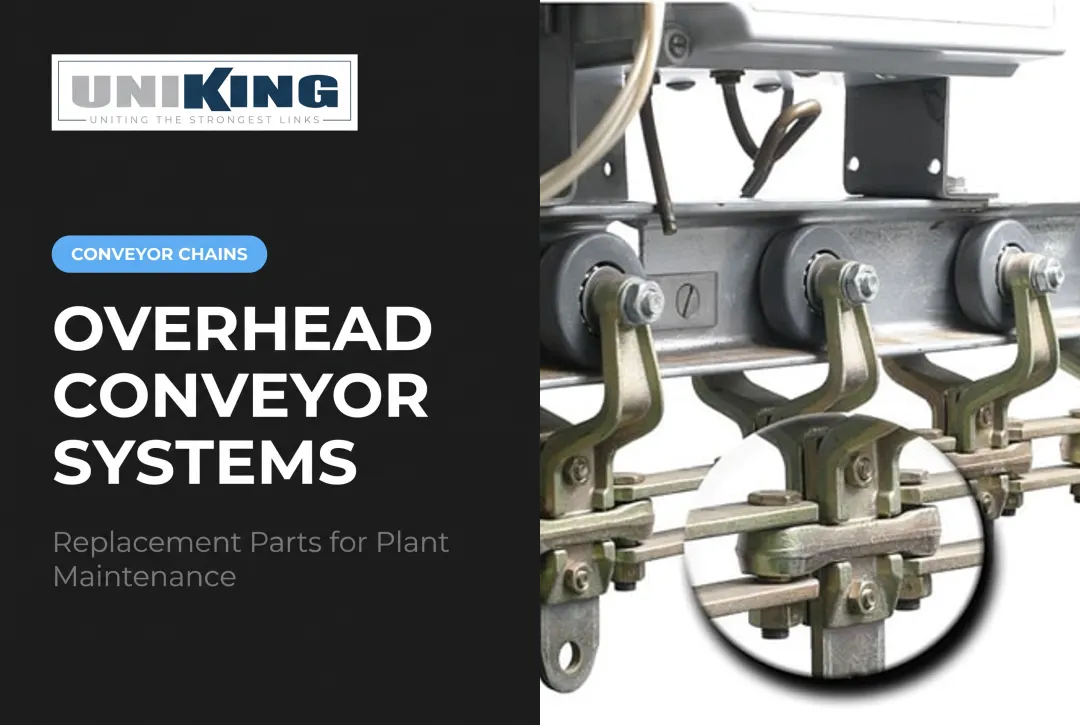
An overhead conveyor chain is a continuous loop that rides an elevated track, carrying product through a facility without touching the floor.
Core Components of an Overhead Conveyor System
Every powered overhead system relies on a handful of core parts:
- Chain loop – the continuous chain that carries the load around the entire circuit
- Track – the fixed rail or enclosed channel that guides the chain's path
- Drive unit – the motor and sprocket assembly that pulls the chain forward
- Take-up unit – maintains correct chain tension as the system runs and wears in
- Carriers/trolleys – attach to the chain and hold the actual product or pendant load
- Electrical controls – manage start/stop sequencing, speed, and safety interlocks
Because the chain is one continuous loop, every carrier on it moves together. This is called synchronous movement: the whole system starts, stops, and travels at the same pace, which keeps timing predictable across an entire process line.
How the Chain Moves Products Through a Facility
The chain itself rides on roller bearings, which cuts friction compared to sliding contact. The drive unit pulls the chain through the track while the take-up unit keeps tension consistent, even after years of wear have stretched the links slightly.
This setup lets overhead systems carry oddly shaped or "non-conveyable" items (automotive body panels, hanging garments, meat carcasses) straight through paint booths, washers, and ovens without the chain's performance suffering.
Overhead systems are also efficient in a way floor conveyors often aren't. A single drive unit can often power a long circuit, so one motor may carry an entire production loop instead of requiring multiple drive points along the way.

Types of Overhead Conveyor Chains & Track Systems
Not every overhead chain looks or performs the same way. The right choice depends on load, environment, and how much flexibility the process needs.
Enclosed Track vs. Open Track (I-Beam) Chains
Enclosed track chains run mostly covered inside the track itself. Only the pendant or attachment point projects through a slot. This design:
- Reduces the risk of contamination — a major reason it's common in food processing and coating lines
- Improves operator safety by keeping moving chain components shielded
- Keeps the chain protected from dust and debris in the process area
Open/I-beam track chains, often drop-forged rivetless designs, expose the chain and trolleys along the beam. They're typically chosen for heavier loads and easier field servicing. Capacity rises with beam size — 3-inch, 4-inch and 6-inch I-beams each carry progressively heavier trolley loads, and a load bar spanning two trolleys raises the figure further.
Enclosed-track pendants generally run lighter, reflecting their focus on washdown cleanliness and precision over raw load capacity.
Power & Free vs. Synchronous Conveyor Systems
In a synchronous system, every carrier moves at the same fixed speed, following the chain exactly. It's ideal when a process needs consistent timing from start to finish.
Power & free systems decouple the carrier from constant chain motion. Carriers can stop, accumulate, or switch tracks independently while the main chain keeps running. This matters for:
- Buffering product between process stages
- Accumulating parts before a bottleneck operation
- Routing loads to different stations without stopping the whole line
Automotive paint lines are a classic example — parts accumulate and route independently through finishing stages without halting the entire conveyor.
Common Chain Construction Types
Chain construction and material selection drive wear life. The main categories:
- Engineered chains — built for a specific application, often with heat-treated high-grade steel and wear-resistant alloys
- Welded steel chains — medium-carbon steel pins and plates, sometimes heat-treated for added strength; adaptable to different pitch and size needs
- Forged chains — drop-forged from high-strength carbon steel, hardened against wear, corrosion, and shock; typically rivetless for tool-free field assembly
- Kiln chains — carbon steel and heat-resistant ferritic or austenitic stainless grades, built for sustained high-temperature exposure and rated to roughly 1200°C (2192°F) service depending on grade and kiln zone
Uniking Canada Inc. supplies all four categories (Engineered Class, Welded Steel, Forged, and Kiln) through partner manufacturers, so specs can be matched to the application rather than forced into a single product line.

Benefits and Industries That Rely on Overhead Conveyor Chains
Key Operational Benefits
Overhead conveyor chains solve two problems at once: space and handling.
- Maximizes overhead space by moving product through air that would otherwise sit empty, clearing the floor for staff, forklifts, and equipment
- Reduces congestion with fewer floor-level obstacles, cutting near-misses and smoothing material flow
- Handles awkward loads too irregular for belts or rollers on hanging pendants or carriers
- Moves product through harsh zones such as paint booths, washers, and ovens without manual handling or worker exposure
Industries Commonly Using Overhead Conveyor Chains
Overhead systems show up wherever floor space is tight or process conditions are demanding:
- Food and beverage plants run washdown-rated chains through processing and packaging, including slaughterhouse and poultry lines
- Automotive and paint finishing lines use power-and-free systems to carry body panels through dip tanks, paint booths, and drying ovens
- Agriculture operations move packaging materials and finished components through crop and equipment processing
- Forestry and wood products facilities move material through cutting, finishing, and drying stages
- General manufacturing relies on overhead lines for assembly and finishing across varied plant layouts
Uniking Canada Inc. 's overhead chain lineup, sourced through its network of 27+ partner factories, covers several of these use cases directly.
How to Choose a Reliable Overhead Conveyor Chain Supplier
An inferior chain doesn't just wear out faster. It creates fatigue points, unpredictable elongation, and eventually breakage. That kind of failure stops a line cold, and every hour of downtime shows up on the cost sheet. Choosing the right supplier is a risk-management decision, not just a purchasing one.
Look for a broad product range. A supplier stocking only one construction type will push that chain into applications it wasn't built for. Uniking Canada Inc. carries overhead, Engineered, Welded Steel, Forged, and Kiln chains, so the recommendation can match the application instead of forcing a single construction into every job.
Check the sourcing model. Global manufacturing partnerships help protect against regional supply disruptions. Uniking Canada Inc. works with more than 27 partner factories across four continents, so a bottleneck at one facility doesn't necessarily leave a Canadian plant waiting.
Ask about technical support. Chain identification, troubleshooting, and maintenance guidance matter more than most buyers expect, especially for less common styles. Uniking Canada Inc.'s Food & Beverage, Agriculture, and Forestry divisions, give plants across Canada support that knows their process—not just the catalogue number.
Confirm lead times and local stock. A chain that's technically "available" but three weeks out doesn't help a plant mid-shutdown. Ask suppliers directly:

- What's the standard lead time for your specific chain style?
- Is common wear-part inventory held locally or shipped internationally?
- What happens if a replacement is needed outside business hours?
Maintenance Tips and Warning Signs of Chain Wear
Maintenance intervals should match the environment, not a generic calendar.
- Standard transport lines: Inspect after the first month, then quarterly, then every six months once performance stays stable
- Process lines with closed wheels: Check weekly at first, then every 4–6 weeks as wear data supports it
- High-heat zones like ovens: Inspect daily at first, then weekly once wear patterns are clear
- Washdown lines: Clean daily and use a lubricant approved for your process
Watch for these warning signs:
- Chain elongation beyond OEM tolerance
- Unusual noise or vibration during operation
- Uneven wear on links, pins, or rollers
- Visible sprocket wear or tooth deformation
Proper tension through the take-up unit extends service life. Loose chain raises slippage and derailment risk; over-tensioned chain wears pins and bushings faster. Regular tension checks catch problems before they turn into downtime.
Frequently Asked Questions
What is the difference between overhead conveyor chains and floor conveyor chains?
Overhead chains suspend loads from an elevated track using hanging carriers or pendants, relying on gravity to hold product in place. Floor conveyor chains support loads directly on a horizontal surface at ground level.
How do I know when to replace an overhead conveyor chain?
Watch for measurable elongation beyond OEM tolerance, visible wear on pins and rollers, and unusual noise or vibration during operation. Any of these signs mean it's time for a closer inspection or replacement.
What is the difference between enclosed track and open track overhead conveyors?
Enclosed track chains run covered within the track, improving safety and reducing contamination risk. Open/I-beam track chains are typically used for heavier loads and offer easier field maintenance.
What industries use overhead conveyor chains the most?
Food & beverage, automotive and paint finishing, agriculture, forestry, and general manufacturing rely on overhead conveyor chains most heavily. Chain style, track type, and finish are matched to each plant’s load, heat, and washdown conditions.
How much weight can an overhead conveyor chain carry?
Load capacity varies widely, from roughly 50 lb on light-duty enclosed-track pendants to well over 1,200 lb per trolley on heavy-duty open I-beam systems. Match duty class and trolley rating to your heaviest hanging load rather than relying on a single catalogue figure.
How often should overhead conveyor chains be lubricated or maintained?
Lubrication frequency depends on the operating environment and usage intensity: high-heat or washdown conditions need more frequent attention than standard transport lines. A routine inspection schedule helps catch wear before it turns into unplanned downtime.