
Introduction
Canadian food and beverage, agriculture, and manufacturing facilities are running out of room. As production scales up, floor-based conveyors hit their capacity limits fast.
The result? Congested aisles, forklifts fighting for space with pedestrian traffic, and bottlenecks that slow everything down. Many plant managers are discovering that the real estate they need isn't on the floor at all. It's above it.
This guide covers how overhead conveyor systems work, the main types available, and their key benefits. You'll also learn how to choose components built for years of continuous operation.
Key Takeaways
- Overhead systems free up floor space by moving product along ceiling-mounted or structural-steel tracks
- Power-and-free designs let carriers stop, accumulate, and reroute independently, unlike fixed monorails
- Chain quality is the single biggest factor in long-term system uptime
- Match system type to load, environment, and accumulation needs to avoid costly retrofits
- Sourcing durable chains and belting reduces unplanned downtime across all overhead configurations
What Is an Overhead Conveyor System and How Does It Work?
An overhead conveyor system moves product along a track mounted to the ceiling or structural steel, keeping loads off the plant floor and clear of ground-level operations. Trolleys travel through workstations, ovens, paint booths, or storage zones without competing with forklift traffic below.
Core Mechanical Components
Every powered overhead system is built around three mechanical elements:
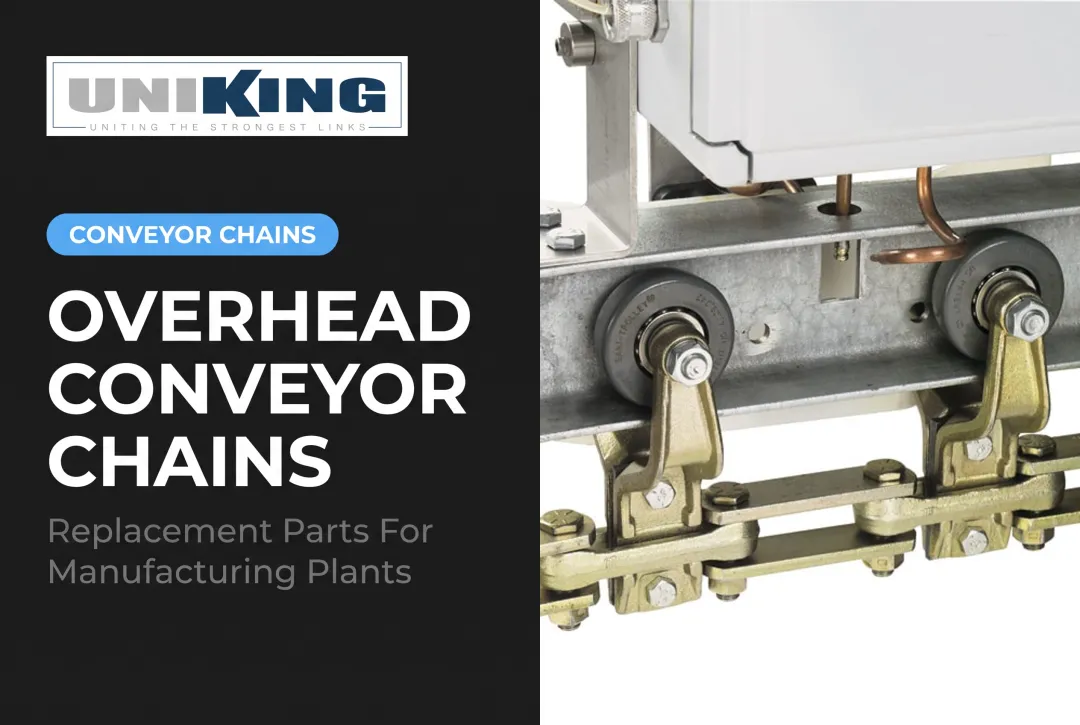
- Continuous chain circuit – a closed loop that pulls trolleys along the track on alternating load-carrying and guide wheels
- Track and trolleys – the formed or I-beam track that carries the trolleys, plus the trolley attachments and load bars that hold the product
- Take-up unit – a spring, counterweight, or air-tensioning device that compensates for chain slack, wear-related growth, and temperature shifts
Of the three, the chain is the part that determines how long the circuit runs before it comes down for replacement.
Synchronous vs. Asynchronous Movement
In a fixed monorail, every trolley connects to the same chain and moves at one pace along one route. There's no independent stopping.
Power-and-free systems work differently. They pair a powered chain track with a separate free-trolley track, so individual carriers can disengage, accumulate, divert, or change speed without halting the entire line.
The chain is the backbone of either configuration. It endures continuous tension, wear, and load cycling for years, so its quality directly determines how often the line goes down for repairs.
Reliability is only part of the operating picture—buyers also ask about energy. A note on energy use: overhead systems don't come with a universal energy-savings percentage over floor conveyors. Actual consumption depends on chain pull, lift forces, load weight, and route length, all of which vary by application. Treat energy as a design variable to calculate for your specific layout, not a fixed advantage.
Types of Overhead Conveyor Systems
The right overhead conveyor type depends on three factors:
- Load weight
- Environmental conditions
- How much independent routing and accumulation each carrier needs
Enclosed Track Conveyors
The chain runs inside a formed steel track, shielding it from contamination and reducing accidental contact. Enclosed track conveyors suit light-to-medium loads in cleaner environments and support short-radius curves without major structural changes.
Power-and-Free Conveyors
A dual-track design pairs one powered chain track with one free-trolley track. Carriers can accumulate, stop, or reroute independently of each other. That flexibility makes power-and-free systems the standard choice for automotive paint lines and multi-zone assembly, where buffering and sequencing matter as much as movement.
I-Beam Monorail and Trolley Systems
Chain-connected trolleys travel together along a fixed I-beam path. This setup handles heavy-duty loads well and stands up to harsh environments like dip coating, curing ovens, and washdown areas. Hand-pushed variants can also include stops, mechanical track switches, and turntables for manual routing.
Overhead Belt, Roller, and Spiral Conveyors
Belt, roller, and spiral designs handle vertical product movement rather than horizontal transport, feeding elevated palletizers or moving packaged goods between production levels. Elevated spiral conveyors maintain continuous flow through tight footprints, which helps when floor space near packaging lines is scarce.
Manual Push-Track and Gravity-Assisted Conveyors
Operators push carriers by hand, or a pitched track uses load weight to create gravity flow. Both options suit low-volume applications or facilities that want the simplest possible mechanical arrangement to maintain. Over-and-under layouts also let empty hooks return on an upper rail, cutting down on wasted trolley trips.

Key Benefits of Overhead Conveyor Systems
Moving product overhead changes how a facility operates in practical, measurable ways.
- Reclaims floor space – ground-level area opens up for equipment, staging, or expanded production lines instead of conveyor footprint
- Improves workflow – forklifts and foot traffic move freely beneath the system, cutting the bottlenecks common with floor-level conveyors
- Enhances safety – eliminates floor-level trip hazards and supports washdown-friendly layouts required in food processing environments
- Supports scalability – facilities can extend routes, add spurs, or reconfigure paths as production needs grow, without ripping out floor infrastructure
Modern Materials Handling has documented overhead systems accumulating and transporting high volumes precisely because they use vertical space that would otherwise sit empty. That's the core advantage: you add usable capacity by putting vertical space to work instead of competing for floor area.
No verified industry-wide percentage exists for floor-space savings or energy reduction versus floor conveyors. The benefit is real, but it's facility-specific. It depends on your current layout, ceiling height, and route design.
Industries That Rely on Overhead Conveyor Systems
Overhead conveyors show up wherever floor space is tight.
- Food and beverage: Enclosed, washdown-friendly systems with stainless components built for daily cleaning and cold storage
- Agriculture and forestry: Bulk materials and wood products, where chains take constant abrasion from chips, sawdust, and ash
- Automotive and industrial: Power-and-free systems on paint lines and multi-stage assembly, so one stalled station doesn’t stop the line
Each industry pushes chains and belting toward different failure points, whether that's chemical exposure, temperature swings, or sheer mechanical stress. That's why component selection can't be generic across sectors.
The Role of Conveyor Chains and Belting in Overhead System Performance
Chain quality determines system uptime more than almost any other factor. The chain carries the load, endures tension cycles, and takes the wear that eventually forces a shutdown for replacement.
Different overhead applications call for different chain classes:
| Chain type | Best suited for |
|---|---|
| Engineered chains | High-load mining, forestry, and bulk handling (up to 3× standard chain ratings) |
| Welded steel chains | High-tension forestry and food & beverage lines |
| Forged chains | Heavy pulling/lifting with repeated bending stress |
| Overhead-specific chains | Continuous overhead circuits; heavy loads or washdown lines |
**Uniking Canada Inc. ** supplies overhead conveyor chains in industry-standard styles such as X348, X458 and X678, along with 348 bolted chain systems, plastic trolley systems, trolley attachments and hand-pushed trolleys, sourced through its network of 27+ partner factories.
These chains are built for heavy loads and high operating speeds in harsh environments. Washdown-friendly material options are available for food processing and slaughterhouse lines.
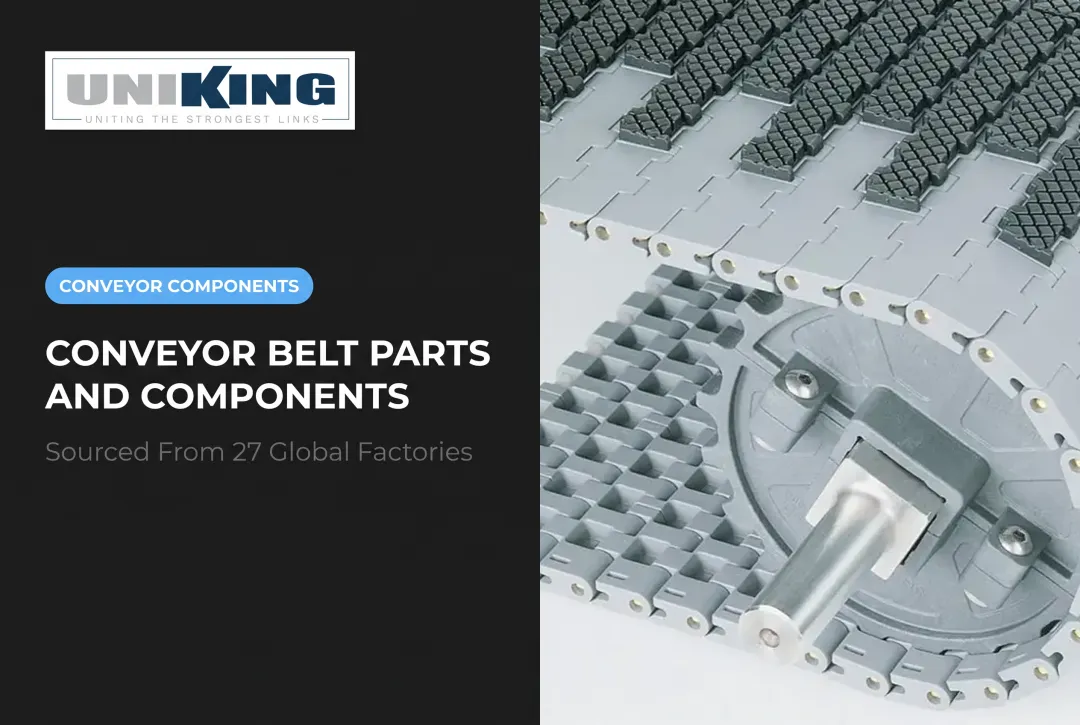
Belting matters where the process needs airflow, drainage, or washdown—not only chain strength. Uniking Canada Inc.'s wire mesh conveyor belting line supports those food processing conditions.
Matched chains and belting help overhead operators in food and beverage, agriculture, and forestry cut unplanned downtime. Uniking Canada Inc. also provides engineering documentation on lubrication and load ratings so teams can match a chain to the application before it goes into service.

Choosing the Right Overhead Conveyor for Your Facility
Selecting the right system starts with three questions, not a product catalogue.
- What's the load type, weight, and dimensions? This determines whether you need a light-duty enclosed track or a heavy-duty I-beam monorail. Capacities range from roughly 113 kg on a single trolley to over 1,360 kg with multi-trolley load bars.
- What are the environmental conditions? Temperature swings, humidity, and washdown needs dictate standard steel versus corrosion-resistant chain. Stainless handles moisture and chemicals but usually has lower tensile strength than carbon steel.
- What does your facility layout require? Clearance, curve radius, inclines, and accumulation zones shape the fit. Choose power-and-free when carriers must buffer or reroute independently; a fixed monorail works when one common route and pace suffice.
Getting these three factors right before ordering components saves far more time than correcting a mismatched chain or trolley after installation.
Frequently Asked Questions
What are the different types of overhead conveyor systems?
The main types are enclosed track, power-and-free, I-beam monorail, overhead belt/spiral, and manual push-track or gravity-assisted systems. Each suits different combinations of load weight, environment, and required accumulation.
How does an overhead conveyor system work?
A continuous chain circuit pulls trolleys along a ceiling-mounted track, carrying product through the plant on trolley attachments or load bars. A take-up unit maintains chain tension as the chain wears and as temperature changes.
What industries use overhead conveyor systems the most?
Food and beverage, agriculture, forestry, and general manufacturing are among the heaviest users. Automotive and appliance plants also run power-and-free systems widely on paint and assembly lines.
How much weight can an overhead conveyor system carry?
Capacity depends on configuration, not a single industry standard. Published ratings run from roughly 113 kg on a single-trolley carrier to over 1,360 kg on four-trolley load bars, by manufacturer and chain series.
What is the difference between power-and-free and monorail conveyors?
Fixed monorail trolleys move together along one route at one pace. Power-and-free systems use a separate free-carrier track, allowing individual loads to stop, accumulate, or divert without stopping the rest of the line.
How often do overhead conveyor chains need to be replaced or maintained?
Lifespan depends on load, environment, and build quality—there is no fixed replacement interval. Matched chain selection, steady lubrication, and routine wear checks do the most to limit unplanned downtime.