
Introduction
A worn belt or a stretched chain can stop an entire production line. For Canadian food and beverage, agriculture, forestry, and industrial manufacturing operations, conveyor systems are the backbone of daily output.
Unplanned downtime is expensive. ABB's 2023 survey of 3,215 plant-maintenance decision-makers found that 68% of Canadian industrial businesses experience an unplanned outage at least monthly. Average losses reach nearly $242,000 CAD per hour.
Facility managers often face a second problem once the line stops: finding a replacement part that actually matches. Is it the belt, the chain, the elevator buckets, or the rollers that need swapping? Ordering the wrong specification means more downtime, not less.
This guide breaks down the conveyor wear parts Uniking Canada Inc. supplies, flags which ones wear out first, and shows where Canadian manufacturers can source dependable replacements.
Key Takeaways
- Conveyor wear parts fall into four groups: belting, chain, elevator buckets and accessories, and rollers
- Belt covers, chain, and bucket fasteners wear first—keep dedicated spares on hand
- Match belt material, chain type, and bucket style to the material being conveyed to cut downtime and extend service life
- Many Canadian plants run chain and elevator buckets rather than belts—select those parts with equal care
Conveyor Belting: Carcass and Cover
The belt does the actual work of carrying material, and it has two parts: the carcass (its internal strength layer) and the cover (its outer skin).
Steel cord carcasses suit high-tension, long-distance, low-stretch applications. Textile ply carcasses cover most other uses, matched by rated tension, ply count, and splice method rather than a generic "light-duty" label.
Cover material depends on the job:
- Rubber covers handle abrasion and impact; food-contact grades must meet FDA rule 21 CFR 177.2600
- PVC covers typically handle a moderate temperature range, suited to general processing
- PU covers tolerate a much wider range, from deep cold to high heat, making them common in food and beverage lines
For Canadian food processors, food-contact surfaces are generally expected to be smooth, non-absorbent, corrosion-resistant, and free of pitting or cracks. Belt material choice matters here.

Modular, Steel Hinged, and Wire Mesh Belting
Not every line runs a continuous rubber belt. Three specialty belting families solve problems a standard belt cannot:
- Modular belting is built from interlocking plastic modules. Damaged sections can be rebuilt in place instead of replacing a full belt, and open-grid versions allow drainage and airflow for washdown lines.
- Steel hinged belting carries hot, sharp, or oily material that would cut or degrade a rubber cover, which makes it common in metalworking and heavy processing.
- Wire mesh belting allows air, water, and heat to pass straight through the carrying surface. Balanced weave, flat wire, and compound weave styles each trade openness against load capacity, and they are the standard choice for baking, cooling, and drying.
Elevator Belting
Bucket elevator legs run a purpose-built belt rather than a general conveying belt. Elevator belting is specified by tension rating, cover gauge, and punch pattern so the bucket bolt holes line up with the bucket style in use. Getting the punch pattern wrong is a common source of spillage and repeat bolt failures.
Conveyor Chains
Agricultural, forestry, and food processing operations frequently rely on conveyor chain instead of belt, and matching the right chain type matters just as much as belt selection.
- Cast chains for abrasive drag conveying in fibre and bulk processing
- Forged chains for heavy-duty pulling and lifting under repeated stress
- Welded steel chains for heat- and corrosion-resistant conveying and drag duty
- Engineered class chains heat-treated from high-grade steel for demanding load duty
- Kiln chains built from high-strength alloy or heat-resistant stainless steel for high-temperature operations
- Sharp top chains for gripping logs in wet, muddy forestry environments
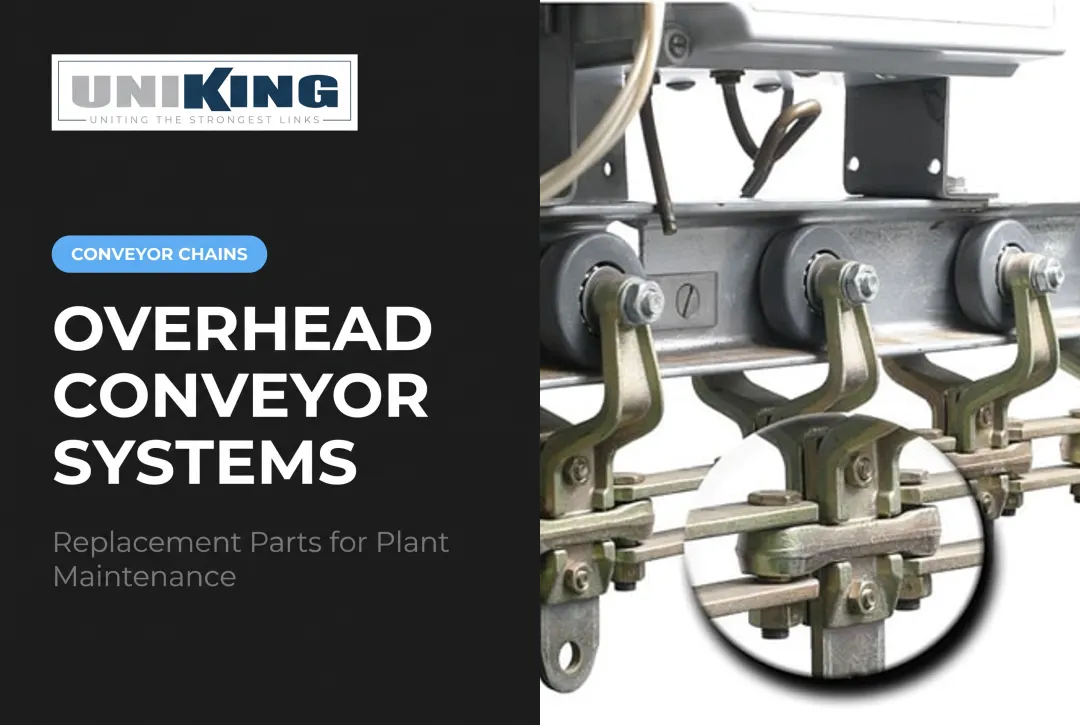
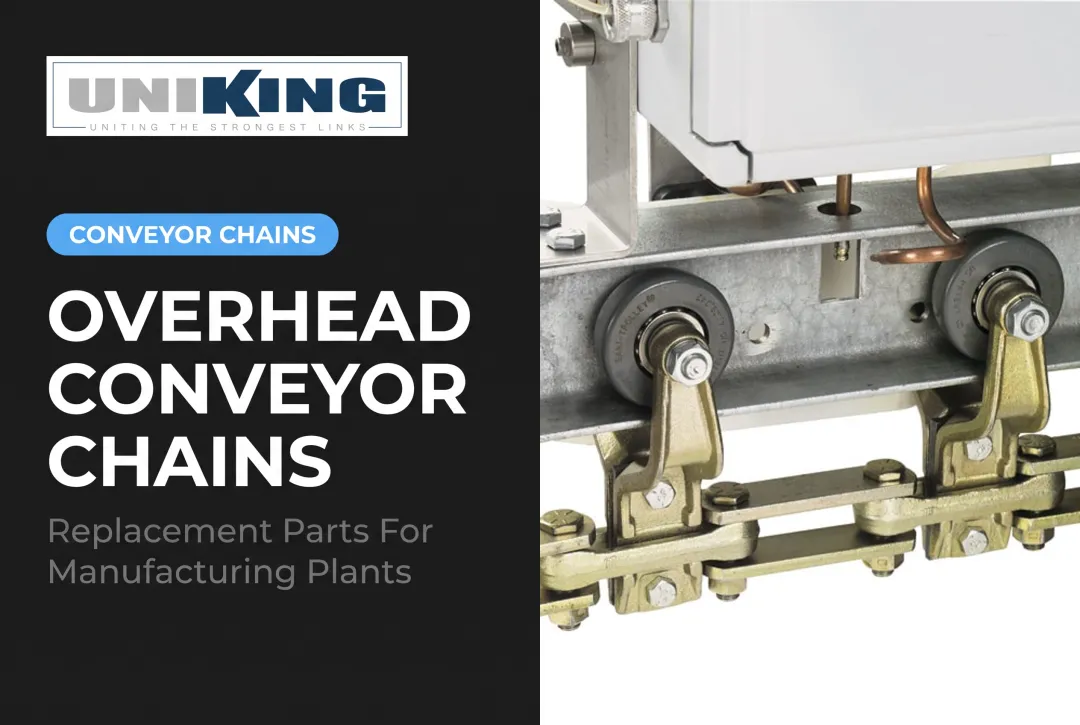
- Overhead chains for continuous overhead circuits, including washdown lines
- Thermoforming and gripper chains for holding and indexing sheet material through forming equipment
Chain wears in two ways worth tracking separately: surface wear on the barrels and sidebars, and elongation as joints wear. Elongation is the one that quietly ruins engagement and starts skipping teeth, so measure pitch over a fixed number of links on a schedule rather than judging by eye.
Elevator Buckets, Bolts, and Accessories
Elevator buckets vertically move grain, wood chips, and food products. Matching bucket style to material matters:
- AA-style buckets suit free-flowing, dry materials like grain
- CC-style buckets handle heavier or abrasive bulk materials
- Continuous-style buckets minimize spillage for fragile or fine products
Buckets are only as reliable as their fasteners. Elevator bolts use a wide, flat head that sits flush against the bucket so material flows past without catching, paired with matching nuts, washers, and spacers. Head style, thread, and length all have to suit the bucket and the belt thickness.
Wrong chain pitch, bucket material, bucket spacing, or bolt length causes premature failure just as reliably as a mismatched belt.
Hazard Monitoring for Bulk Handling
Grain, wood, and bulk processing operations pair mechanical parts with hazard monitoring so problems are caught before they become failures. Monitoring covers belt speed and alignment, plug and level detection, and temperature at critical points on an elevator leg, giving crews a warning while a fix is still routine.
Sourcing Specialty Conveyor Parts in Canada
General industrial catalogues rarely stock kiln chains built for cement and lumber-drying kiln conditions, or the full AA/CC/Continuous bucket range with matched fastening kits.
Uniking Canada Inc. operates as a specialty conveyor parts distributor, working with a global partner network spanning 27+ factories across four continents. That network gives Canadian manufacturers access to belting, chains, elevator buckets, rollers, and accessories that general catalogues typically don't carry, plus expert guidance to identify the correct part before ordering.

For facilities in food and beverage, agriculture, forestry, or bulk material handling, that sourcing depth often makes the difference between a quick swap and an extended shutdown.
Frequently Asked Questions
What are the parts of a conveyor belt?
The parts that get replaced most often are the conveying surface itself—belt or chain—along with elevator buckets and their bolts on elevator legs, and the rollers that carry and move the belt. Matching each to the conveyed material and duty cycle matters more than the brand on the label.
What is the end of a conveyor belt called?
The loading end is called the "tail" and the discharge end is called the "head." Belt and chain wear usually shows up first at the loading end, where material impact is heaviest.
What is the most important part of a conveyor system?
The conveying surface—the belt or the chain. It contacts the material directly and takes the most wear, so it sets the replacement cycle for the whole line.
How do you maintain conveyor parts?
Inspect belt covers and chain visually, measure chain elongation over a fixed number of links, check belt tension and tracking, confirm bucket bolts are tight, and lubricate chain to the manufacturer's schedule. Set a consistent schedule rather than reacting only after a failure occurs.
Which conveyor parts wear out first?
Belt covers, chain barrels and sidebars, roller lagging, and elevator bucket lips typically wear first. Keeping these as spare stock reduces the risk of extended downtime.
How often should conveyor rollers be replaced?
Replacement frequency depends on load, speed, and material abrasiveness. Watch for unusual noise or resistance to turning; these are the clearest early warning signs of a roller that needs attention.